

The ancient Gbaya tribe of the former Oubangui-Chari — now known as the Central African Republic — has passed down a traditional proverb:
“It is not shameful to fall before the mountains, but it is utterly disgraceful to deny their strength.”
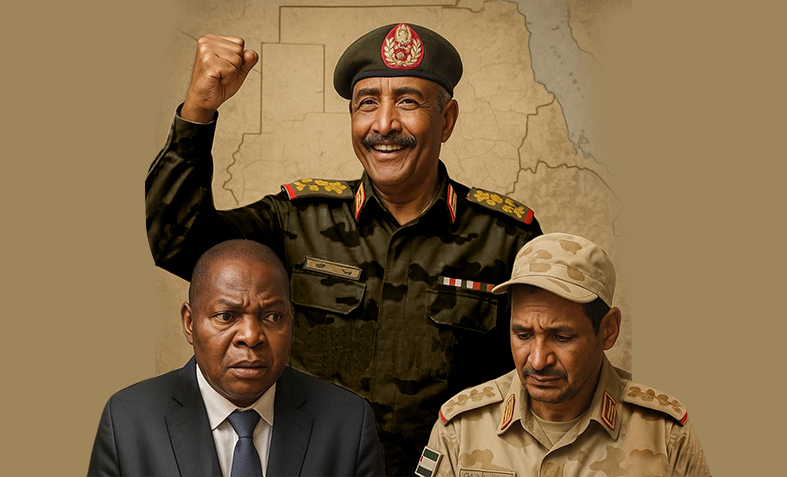
The administration of President Faustin-Archange Touadéra was the first among Sudan’s regional neighbors to assess the war between the Sudanese Armed Forces and the Rapid Support Forces (RSF). Despite Bangui’s ambiguous — or arguably complicit — stance on the Sudanese crisis, its geographical proximity placed it under local, security, and intelligence pressure. The only escape from this encirclement lies through Khartoum. This reality applies to all of Sudan’s neighbors. However, Bangui has shown the most courage and willingness to reverse course and admit the miscalculation of having once bet on the RSF.
There is a longstanding conviction, shared from Bangui to N’Djamena and Addis Ababa, that national security is tied to proximity to — or distance from — Khartoum. This presents an opportunity not only for Bangui, which seeks Sudan’s favor via Russian channels, but also for Sudan to reassert its regional influence.
The Central African Republic’s delegation visit to Sudan aims to secure Khartoum’s position on two key issues:
🔆 The leaders of the Coalition of Patriots for Change (CPC).
🔆 The case of Armel Sayo.
Bangui believes Khartoum is uniquely capable of controlling the growing opposition in the Central African Republic. Despite security efforts to pressure Sayo — including the detention of family members and their transfer to different prisons in late April, and his recent handover via Cameroon — such measures failed to counter the rising influence of the Military Coalition for the Salvation of the People, which Bangui believes is backed by Sudan.
President Touadéra’s administration fully understands Khartoum’s potential role in either strengthening or undermining its national security. Thus emerged the Strategy of Convergence and Cooperation with Sudan, a necessary shift after the failed reliance on the RSF.
Khartoum would do well to activate a “vision-sharing” strategy, provided that Bangui’s demands are clear, precise, and grounded in respect for Sudanese sovereignty and recognition of the role Sudan’s institutions play in regional stability. Like its neighbors, Bangui has experienced the fallout of the Sudanese crisis on its internal security, reaching a state of political hesitation on several pressing matters.
Accordingly, the Central African delegation currently in Sudan is expected to address the following points:
🔆 Set a timeline for implementing the Strategy of Convergence and Cooperation, as agreed upon by both presidents during their UN Security Council meeting.
🔆 Address the PK5 district issue in Bangui. While Khartoum understands Bangui’s strategic view of PK5 as the capital’s economic hub, Bangui is also aware of Khartoum’s security and intelligence ties with armed groups in the area.
🔆 Leverage Khartoum’s influence over the armed opposition to lay the groundwork for national reconciliation, a key issue troubling the Central African Republic.
🔆 It is not unlikely that Bangui will request Khartoum’s assistance in convincing Armel Sayo to dissolve the Military Coalition for the Salvation and Reconstruction of the People, which he founded.
It is recommended that Khartoum adopt the following actions:
🔆 Maintain an equal distance from all parties to the Central African Republic’s internal conflict, especially as long as Bangui continues its tacit support of the RSF.
🔆 Retain the card of the Central African opposition confidentially. Although this may unsettle Bangui, it serves as a guarantee of their commitment to neutralizing the RSF and undermining its agenda — a legitimate right for Khartoum after its bitter experience with militias that compromise state sovereignty.
🔆 Amplify, both in media and diplomacy, that the war waged by the RSF against Sudan’s armed forces is a war to dismantle the Sudanese state, its resources, its national institutions, and its people. It is far removed from any vision of national will, social justice, or democratic equality. Confronting this threat and its backers is a sacred duty.
🔆 Reaffirm to all international diplomatic missions that all Sudanese military and security bodies are aligned in their understanding that the multi-national RSF militia is merely a tool for reshaping the regional map in ways that conflict with Sudan’s future and the broader interests of the Horn of Africa.
🔆 Consistently highlight, in all diplomatic platforms, that all international stakeholders in the Sudanese crisis have been forced to reconsider their political and security approaches, as they have come to realize the impossibility of achieving their objectives through lawless groups — no matter how much logistical support they receive or how many actors back them.
Dr. Amina Al-Araimi
Emirati Researcher in African Affairs


