An ancient African proverb from the venerable Serer tribe of West Africa says:
“When a man sees no emergency exit, he runs in every direction.”
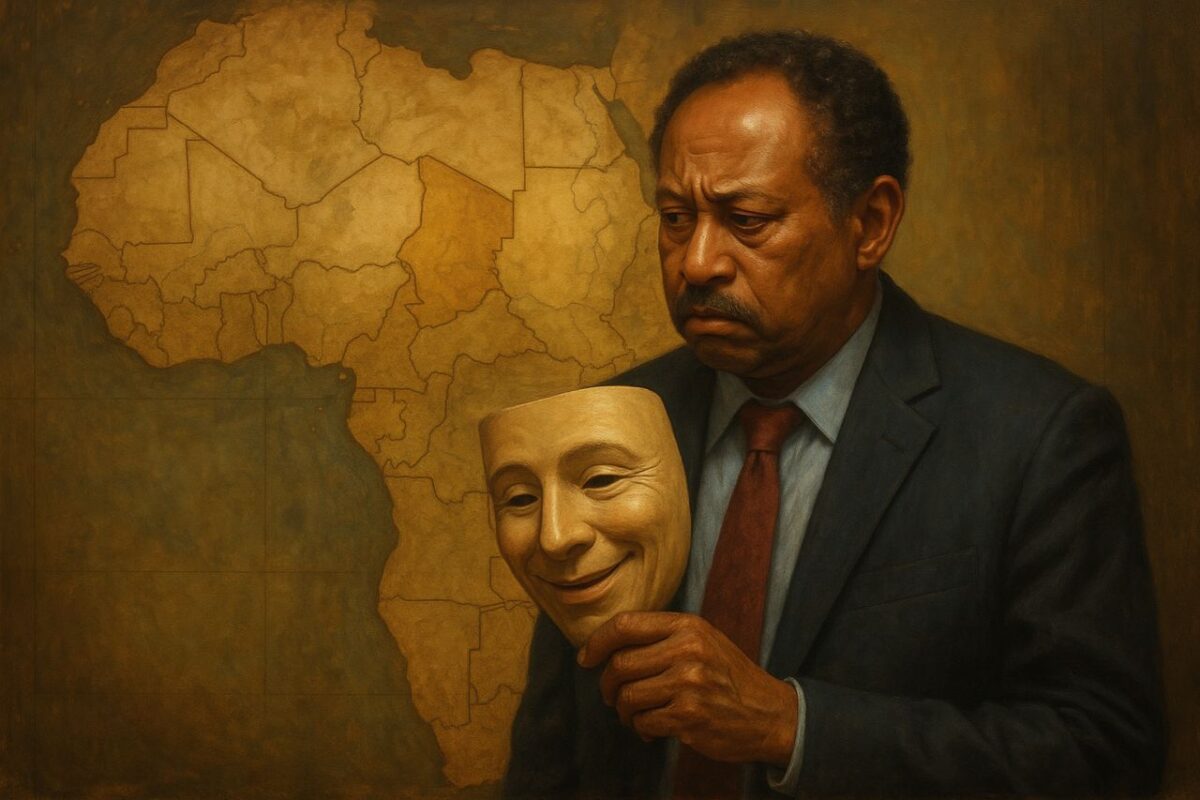
Since January 2024, a coded expression has circulated among journalists and opinion writers in Francophone African countries when referring to the “Tagaddum” coordination body — from which the “Sommoud” Alliance emerged — or to the Rapid Support Forces (RSF) militia. That expression, now widely adopted by African affairs analysts and researchers, has crystallized into a popular phrase: “A mask on a lifeless face” (Un masque sur un visage mort). This alone is enough to gauge African public opinion regarding the Sudanese political scene — a scene that, for the first time in modern African history, has exposed a clear rupture within its components. Francophone African elites have grasped this reality and are now shaping their strategic visions around the same constraints and guarantees that marked the alliance’s emergence at the confluence of the Blue and White Niles.
According to French security sources, Dr. Abdalla Hamdok, leader of the Sommoud Alliance, is preparing for a tour of several West African countries. This comes as the U.S.-backed Quartet Committee prepares to convene a high-level meeting this July to end the war in Sudan. The news has drawn substantial attention — though little enthusiasm — from political and security circles in West Africa. This tepid reaction stems from the emergence of three major perspectives that have taken shape since April 15, 2023:
🚫 First Perspective:
From the outset, this camp did not consider the “Tagaddum” coordination a genuine rescue platform for Sudan — and certainly not now in its reincarnation as the Sommoud Alliance. Their skepticism is rooted in a deep understanding of statehood, democratic transition, war, and peace. While the Sommoud Alliance criticized the Sudanese leadership’s stance in eliminating the RSF rebellion, it paradoxically found alignment with the very rebel group — despite being fully aware that the RSF’s uprising was not about justice or democratic values, but rather a calculated attempt to dismantle Sudanese state institutions and replace them with a parallel militia-led regime. The idea of civilian governance, if genuinely sought, would logically begin with respect for the state’s legitimate institutions — even amid internal disagreements — and absolute rejection of armed rebellion. This perspective advocates for diplomatic engagement, even through international or regional mediation, and views the current approach as undermining the very notion of a national state.
This group’s vision is strategic, aiming to preserve and evolve the future of African nation-states. It emphasizes reforming political systems, encouraging citizen engagement, and developing robust electoral mechanisms to strengthen democratic representation and participatory governance.
🚫 Second Perspective:
This group agrees with the first in all but one key distinction: they were strong advocates for Abdalla Hamdok’s appointment as Prime Minister following Bashir’s fall. They saw his leadership as a golden opportunity to revive the vision of a unified “Greater Sudan” (Le Projet du Grand Soudan). With international stature and wide grassroots acceptance, Hamdok embodied hope for democratic renewal. However, his decision to return post-coup and cooperate with outlaw militias, effectively legitimizing the RSF’s crimes against the state, has deeply disappointed his former supporters. They now view his current role as merely fulfilling a predefined script, soon to reach its conclusion.
This perspective rejects authoritarianism and champions robust multiparty politics and civic participation. While it enjoys broad popular backing in West Africa, it faces structural challenges — chiefly, the immaturity of democratic practices in many African nations.
🚫 Third Perspective:
This group pays minimal attention to developments in distant African regions. Although they monitor Sudan’s unfolding crisis, they refrain from taking a firm stance. However, they uphold a key principle: the integrity of a civilian-led state is inseparable from the endurance of its national military institutions. From this vantage point, the legitimacy and continuity of the state rest entirely on the survival of its armed forces.
They are neutral regarding Sudanese civilian movements, whether post-December Revolution or earlier, preferring instead to rely on internal security assessments and geopolitical analysis. If these assessments align with their national values and do not contradict international norms, then and only then is support considered.
Summary Analysis from an African Perspective:
- Hamdok’s upcoming African tour is seen as a tiresome replica of RSF leader Hemetti’s January 2024 tour — a tour funded by those willing to host it, yet one that offers no real political roadmap for Sudan’s future. The so-called “Founding Government” announced by Hemetti and endorsed by Sommoud lacks legitimacy and domestic support.
- African political decision-making centers — including those previously entangled in supporting the RSF’s transnational ambitions — now realize that international hopes for a quick power grab by the RSF have been dashed. Sudan’s national army has firmly asserted that any foreign access to national assets must pass through legitimate state institutions.
- The international community is increasingly disillusioned. It gambled on the RSF, but the military foundations built during the 1989-2019 era of the Sudanese state — for better or worse — have proven too resilient to collapse. If not for the steadfastness of Sudan’s state institutions, the RSF might have already seized full control.
- After three years of missteps, regional and international players are gradually conceding that time cannot be reversed. Hopes pinned on initiatives like the British Foreign Secretary’s visit to the Adré crossing or future UN visits to Port Sudan will not override the emerging reality: a new Sudan, free of militias, is clearly on the horizon.
Dr. Amina Al-Araimi
Emirati Researcher in African Affairs


