

All global military schools emphasize that one of the fundamental principles underpinning military doctrine is the rule: “In national sovereignty battles, every moment the will hesitates, reality decides for us.”
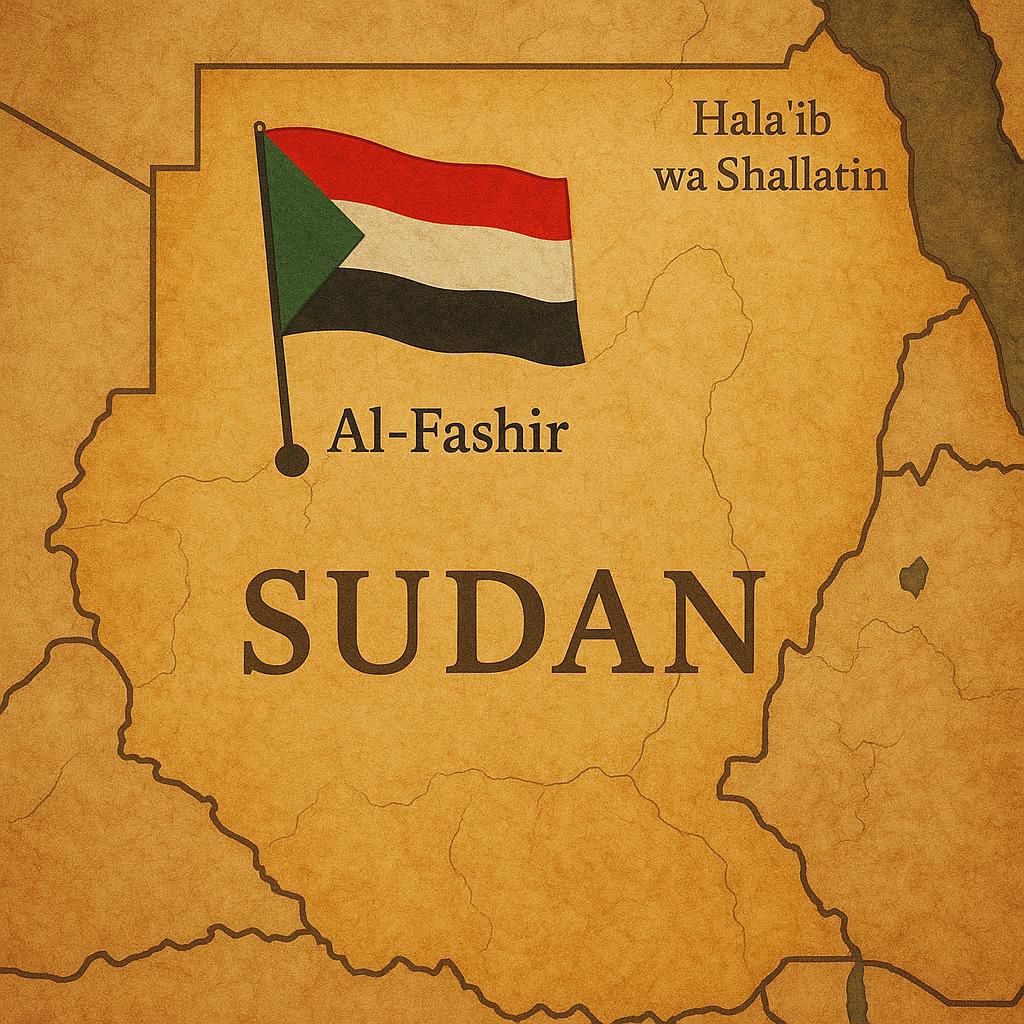
The fall of El Fasher came as a continuation of—or, rather, a response to—the theatrical negotiations sponsored by the U.S. administration over the past three days. Washington, although aware of the reality of the Sudanese war, no longer has the capacity to prolong it or bear its consequences. It had been assumed that the impact would remain confined within Sudan’s borders, but Washington—and not alone—was mistaken. Even international actors ceased to properly analyze Sudan’s internal dynamics following the success of South Sudan’s secession in 2011, as if Sudan, in the Western and allied imagination, no longer had leadership capable of resistance, planning, and confrontation when necessary. These actors failed to account for the presence of multi-ethnic, multinational, and multi-loyalist militias that enjoyed unprecedented support and sponsorship, unmatched even in Africa’s colonial history.
There is no doubt that the fall of El Fasher negatively affected the future of Sudanese political dynamics. However, this does not necessarily mean its permanent loss. Not every loss constitutes a defeat. A truly resilient state—especially one that has accumulated historical and political awareness over decades, gained political experience, and developed its military and security institutions in practice—is a state that understands itself. Consequently, its ability to create a resurgence point surpasses its ability to wait passively.
The internal challenge imposed on the Sudanese Armed Forces, coordinated regionally and internationally, while attempting to dismantle Sudan’s national state apparatus and delegitimize its institutions, inadvertently contributed to the emergence of the Sudanese military on regional and international levels. This prominence is unparalleled in the modern history of African militaries. For those who understand public consciousness, this demonstrates the enduring strength of national armies independent of external supervision and foreign management.
To safeguard internal stability, support the operational trajectory of military actions, and maintain the morale of units supporting the Sudanese national military, it is imperative to confront the increasingly frequent calls from Rapid Support Forces (RSF) media platforms threatening to retake control of the Sudanese state headquarters in Khartoum and expand the conflict to northern states. These militias, despite nearly three years of conflict against the national state, fail to grasp the distinction between state agendas and a state of agendas. Yet, such calls, although often disconnected from field realities, are rarely made arbitrarily, especially given the ongoing RSF logistical support.
Accordingly, the following measures are proposed:
- Align with Turkish efforts to enhance and expand aerial surveillance operations in the Horn and East Africa, particularly after the successful establishment of an operational hub in West Africa. This complements U.S. attempts to expand reconnaissance and intelligence activities in post-war Sudan, evidenced by the recent deployment of U.S. intelligence officers to Port Sudan. This also continues the expansion of Berry Aviation, whose DHC Dash 8-200 and DHC-6-300 Twin Otters are operational in several African states.
- Develop military cooperation with Russia’s Rosoboronexport, whose ties to Khartoum date back to 2001 but are now seeking expansion. Notably, this Russian company triggered U.S. concern in 2019 after signing a security and military partnership with Lomé, prompting Washington to implement programs for equipping the Togolese army—a move that upset Paris, especially after Lomé refused to renew its contract with the French company EPEE, which had been training Togolese special forces. This reflects the intensifying international competition from the Gulf of Guinea, across the Sahel, to the Horn and East Africa.
- Replicate the BIT-7 battalion, a key African unit countering cross-border militias. Its commander, during a visit to Khartoum, famously stated: “Today, we experience concrete shared security, a concept we only knew as a distant idea.” The Sudanese state could divide this battalion’s mission into two components:
- Security, focusing on military movements across borders with South Sudan, the Central African Republic, and Chad.
- Political, fostering engagement with African political circles recognized as security cores (cœur) to facilitate grassroots diplomacy reflecting post-war Sudan. This approach reinforces Sudan’s popular diplomacy efforts initiated since January 2024. Sudan should coordinate with sympathetic African security leaders, such as Íso, a prominent voice opposing cross-border militia projects.
- Review the 2024 cooperation agreement proposed by the Chinese company Hongdu, reportedly through secret channels.
- Invest in African cultural councils and scientific forums, which since early 2024 have hosted political discussions on the Sudanese crisis, culminating in the Horizon du Soudan initiative. This positive African engagement offers Sudan an opportunity to participate not as a mere partner but as a necessary actor shaping outcomes.
- Deploy a Sudanese security team fluent in French to monitor new French initiatives in post-war Sudan, especially following Elie Tenenbaum’s “Militarized Gray Zones” strategy, which emphasizes transitioning from indirect to direct intelligence in countries with multiple power centers.
- Establish a professional Sudanese-African media channel to convey the truth of Sudan’s situation, expose RSF crimes, and highlight the militia’s cross-border objectives. Recruitment should focus on experienced African journalists who have consistently demonstrated professional coverage of Africa’s political, security, and intelligence issues. If establishing a new channel is impractical, Sudan could partner with influential African networks such as Channels, SABC, or Africanews to feature segments revealing RSF’s transnational agenda.
- Implement a strategy of balanced openness, enabling cooperation without committing to fixed alliances. Known in French political literature as la neutralité active, this approach allows states to act for peace without allegiance to a particular bloc—precisely what post-war Sudan needs.
- Send Sudanese delegations to West African security institutions to expose the dangers of RSF projects, which aim to:
- Divide national states.
- Incite ethnic militias in West Africa.
- Seize critical resources and mining operations to impede economic development.
These delegations would foster regional public awareness aligned with political consciousness resisting projects undermining African national unity.
- Distinguish between the “actor” and the “executor.” In political science and international relations, “great politics” (politique majeure) is often compared to a chessboard: smaller states are moved while great powers plan their steps unseen. African populations must understand this dynamic in the context of the escalating unrest in Sudan.
Dr.Ameena Alarimi
Emirati researcher in African affairs


