
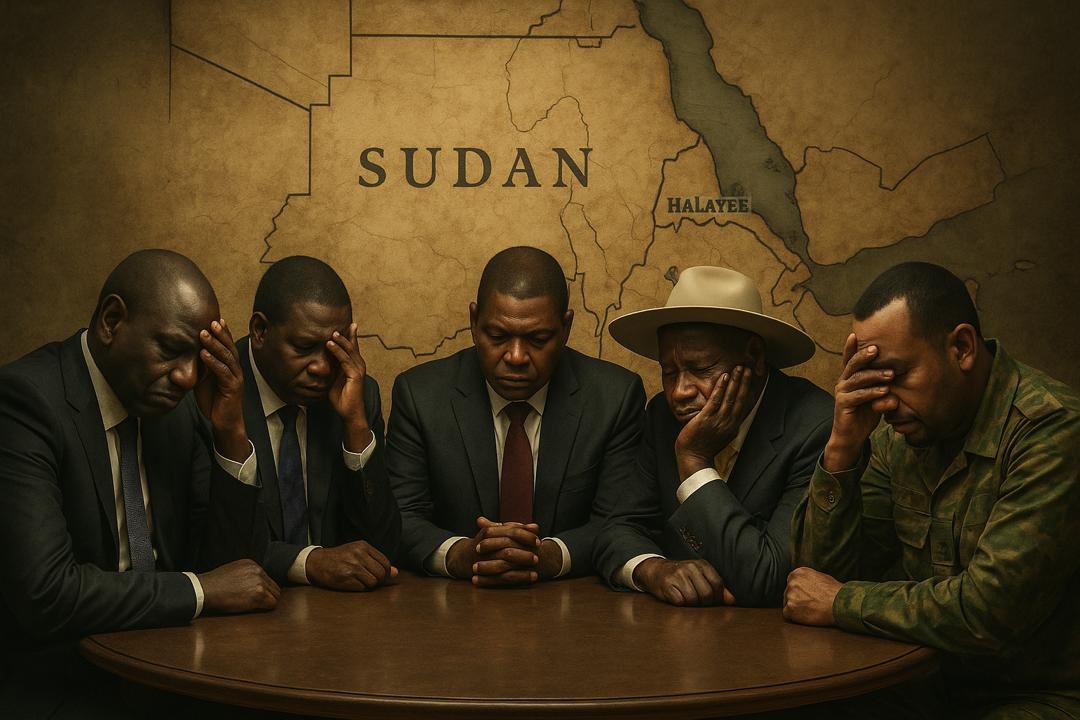
In early French academic sources, Sudan was referred to as the “Land of Fortunate Destiny” due to its pivotal geographic position connecting diverse African nations, its abundant natural resources, and its rich cultural plurality. This designation dates back to the colonial era following the Berlin Conference (1884–1885), which marked the beginning of European partitioning in Africa. Sudan has long been perceived as both an extension of “East Africa” and a continuation of “West Africa,” bearing the intellectual, cultural, political, and religious legacies of its ancient civilizations—Kerma, Kush, and Meroë. The enduring influence of these societies on Africa’s collective consciousness is evident upon examining their preserved manuscripts.
Since January 2024, Sudan’s regional neighbors—including Ethiopia, Kenya, Uganda, South Sudan, Chad, and the Central African Republic—have experienced a wave of political euphoria. Many in these states firmly believed that the pillars of Sudanese statehood—historically a source of pride for the Nile Valley region—were collapsing. However, their deep-rooted political histories overlooked an essential truth: no external power has ever successfully subdued Sudan. As Jean Marchand remarked to French Foreign Minister Théophile Delcassé during the 1898 Fashoda Crisis, “Sudan can only be subdued by Sudan itself… we do not want French soldiers echoing the words of the British after their defeat at Sheikan in 1883, that ‘Sudan is a land where empires die.’ We do not wish death upon our own French empire.”
The accumulated political experiences of Sudan’s neighbors should have tempered their diplomatic, intelligence, and security maneuvers. Instead, a profound intellectual fragmentation has undermined coherent strategy and harmed regional credibility. The Sudanese leadership’s recent announcement of the gradual restoration of critical state institutions in Khartoum—coinciding with the appointment of Prime Minister Dr. Kamel Idris—has prompted each neighboring capital to reassess its approach to post-war Sudan. While their perspectives diverge, they share a consensus: the Sudanese military has, since 2023, established a new security and intelligence paradigm that will redefine Khartoum’s regional relations. From an African standpoint, this development signals Sudan’s intent to pursue novel internal security doctrines and to adopt a more assertive foreign policy befitting a nation that has weathered existential trials.
With Prime Minister Kamel Idris’s “Government of Hope” on the horizon, Sudanese leadership should prioritize key strategic dossiers to strengthen internal unity, reinforce national security, and protect state sovereignty. Among them:
🔆 A targeted diplomatic “sectoral” approach:
•Propose a quid pro quo to Bangui—accept Russia’s impending “African Corps” deployment (scheduled for 2026) without bearing financial costs—to secure unhindered mobility for the Sudanese Armed Forces in northeast Central Africa. The objective: systematically dismantle the Rapid Support Forces’ (RSF) border logistics networks.
•Negotiate defense terms so Bangui agrees to the Russia-Central African Republic deal without burdening itself financially—mirroring prior arrangements with the Wagner Group—while Sudan signals to Moscow its capacity to influence Bangui decisively. African security analysts have referred to Khartoum as the “compass of stability” in the CAR, noting its ability to sway political opposition circles in Bangui. If Central African President Touadera is indeed distancing his country from Russian influence and approaching the U.S. and France, Russia must show flexibility to preserve its influence—and Sudan gains corroboration of Bangui’s intentions regarding regional cooperation and border security.
•Should Bangui reject Sudan’s proposal, Khartoum can deploy strategic levers such as PK5 and AAKG—unrest in CAR’s southeastern provinces since May indicates Russian failure to maintain stability, as armed groups continue to recruit from neighboring states—underscoring Khartoum’s potential pivot over political outcomes.
Strengthen ties with the “African Progressive Leaders’ Solidarity Network,” a coalition expanding its influence among African political elites and international bodies (African Union, UN). Key members include former Kenyan Justice Minister Martha Karua and Franco-Comorian lawyer Saïd Larifou, a prominent figure in West Africa. Khartoum could appoint Dr. Qutbi al-Mahdi or a trusted associate to lead this initiative, providing Sudanese diplomatic missions in Francophone West Africa a covert channel to counterbalance Nairobi’s interference, which has supported the RSF and hindered Sudan–Bangui rapprochement.
Monitor Ugandan political and intelligence maneuvers, which have lacked clear direction since April 15, 2023. President Yoweri Museveni is acutely aware of Khartoum’s capacity to disrupt Ugandan influence in the Great Lakes—as witnessed during the 1990s. Given Kampala’s perceived support for the RSF, Khartoum may channel aid to Ugandan opposition groups such as Robert Kyagulani’s National Unity Platform, which recently secured support in the U.S. Congress for its democratic and governance agenda—potentially influencing Uganda’s military and intelligence communities.
Prepare for developments in Juba: the visit of Sudan People’s Liberation Movement–In Opposition (SPLM‑IO) leaders to Addis Ababa and their talks with French officials—following SPLM‑IO defections—could either lead to a technocratic transitional government or escalate into armed conflict, depending on whether the movement asserts its undeployed military capacity.
Establish a cohort of Sudanese university graduates in French Studies—selected after rigorous security vetting—to revive the “Greater Sudan Project.” First advanced in 1956 by Ahmed Mohamed Yassin, this initiative envisions, beyond the historical unity of North and South Sudan, outreach to Eritrea, Benishangul, Chad, CAR, and northern Uganda. Unlike colonial-era interpretations, today’s Francophone elites in West Africa perceive this as a restoration of ancient ties traced to French expeditions (1896–1899)—a vision Malian, Ivorian, or Senegalese intellectuals now find compelling.
Reinforce cultural diplomacy by engaging with African institutions dedicated to historical scholarship. Sudan participated only intermittently in activities led by organizations like CRSAC (1994–2019) and Nigeria’s CDAA. Greater, consistent involvement in their conferences and seminars would amplify Sudan’s role in continental cultural narratives.
A scholarly contribution by the researcher is available at the following link:
https://mogadishucenter.com/2025/06/%d9%85%d8%b4%d8%b1%d9%88%d8%b9-%d8%a7%d9%84%d8%b3%d9%88%d8%af%d8%a7%d9%86-%d8%a7%d9%84%d9%83%d8%a8%d9%8a%d8%b1-%d9%8a%d8%aa%d8%ac%d8%a7%d9%88%d8%b2-%d8%af%d9%88%d9%84-%d8%a7%d9%84%d8%b7%d9%88%d9%82/
Dr. Amina Al-Arimi
An Emirati researcher specializing in African affairs.
An Emirati researcher specializing in African affairs.


