

During my postgraduate studies in political science, the course on strategy and national security was among the heaviest and most demanding subjects. It was the only course that generated an inner conflict within me—one I vowed to confront and overcome. It was also the only course that compelled me to travel to several African, Arab, and European capitals in search of references unavailable in the virtual world. The more I absorbed its meanings, the more my thirst for deeper understanding intensified. It forced me, against my will, into the field of military sciences—an area I had previously avoided reading about, let alone comprehending. It was the sole discipline that, whenever I carved out time to write an article or conduct an interview, imposed its rules before me, as though political science had produced nothing else.
Old English military literature states: “After independence, the Sudanese state succeeded in addressing the major security gap within its military system, represented by the absence of middle leadership. The concept of middle leadership was precisely what the Sudanese military command lacked, reinforcing rigid centralization and depriving it of combat flexibility. However, the vision of ‘Sudan under General Ibrahim Abboud’ for the future of the military institution converged with that of General Yahya Khan, Commander-in-Chief of the Pakistani Army in 1966, who personally oversaw the training of a Sudanese Armed Forces delegation at the Pakistan Military Academy during the 1960s.”
Following the announcement of the recent military deal between Khartoum and Islamabad, I began monitoring African reactions, particularly among African states that now perceive the Sudanese scene as a reflection that could affect their own realities should they fail to grasp the true nature of the international conflict in Sudan—one aimed at dismantling national state institutions and replacing them with transnational militias operating outside the law. Although Africa’s largest security platform, the African Peace and Security Architecture (APSA), did not comment on the outcomes or dimensions of the deal and instead opted for silence and observation, the reality extended beyond that. Three discussion sessions—akin to brainstorming workshops—were convened under the supervision of prominent Anglophone dialogue platforms affiliated with the African Issues Forum in Abuja, Nigeria. These sessions were attended by a group of African military leaders, enriching the debate and leading participants to highlight two key points:
- First: The conflict doctrine of the Sudanese military institution, which—“from an African perspective”—is no longer confined to weaponry, but has expanded into what is termed in military intelligence as Rationalité conflictuelle, a combat doctrine that prioritizes the logic of action rather than its form.
- Second: The importance of security and military cooperation with Islamabad, particularly after Pakistan emerged, since March 2025, as a covert supplier to the armed forces of several African states.
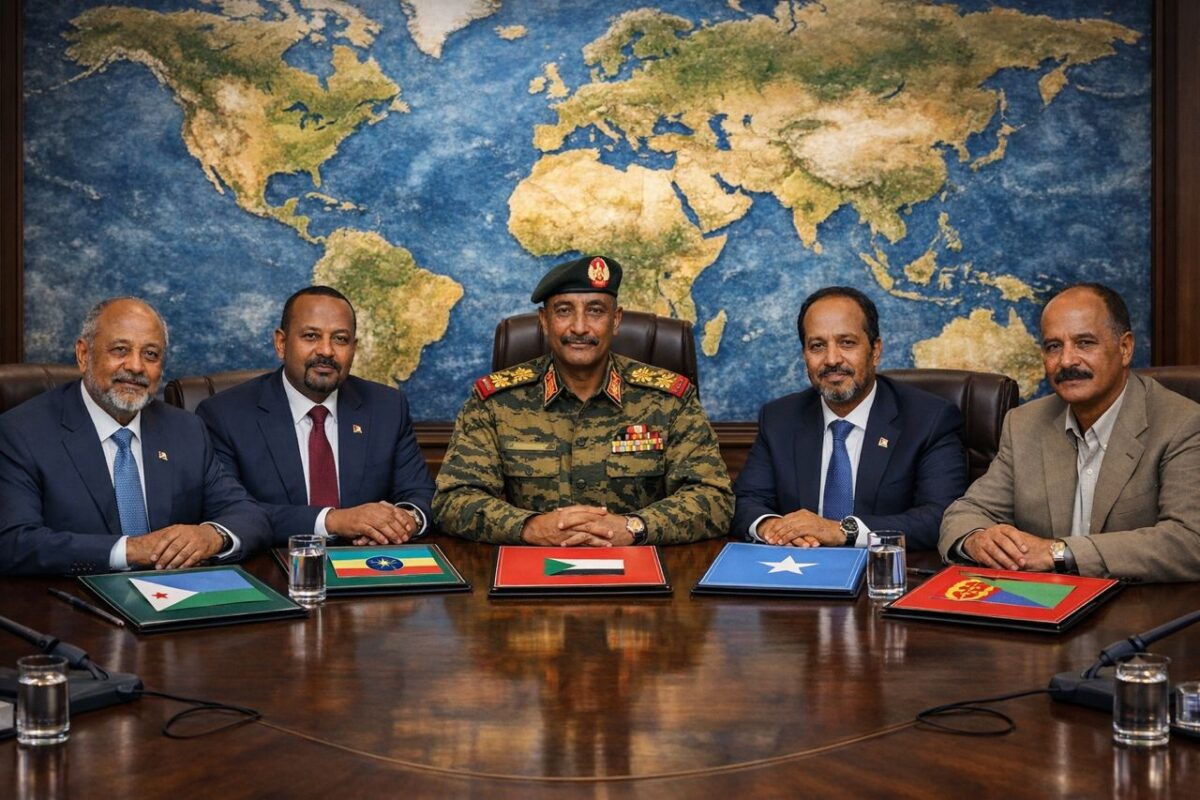
Recent security and political developments in the Horn of Africa and Yemen have cast their shadow over the Sudanese leadership’s outlook, with its recent political and military operations now proceeding according to the first principle of military doctrine: “In battles of national sovereignty, every moment in which willpower is delayed allows facts on the ground to decide for us.” Despite on-the-ground realities confirming the Sudanese state’s advance—following the Armed Forces’ control of Kweik on the South Kordofan axis, the defeat of the transnational Rapid Support Forces militia, and the resumption of official operations by the government and all sovereign institutions from Khartoum for the first time since the onset of the crisis—the issue of Sudan’s eastern borders with Ethiopia has resurfaced. The RSF leadership views the most troubling concern for the Sudanese government today as the continuous reports, supported by documented imagery, confirming the militia’s mobilization of personnel and equipment along the Sudanese–Ethiopian border—an explicit signal of an impending military offensive against Sudan’s eastern states, particularly Gedaref, paving the way for full control over Sudan’s Red Sea coastline. This scenario raises profound alarm, especially amid continued logistical support for the RSF. However, this scenario appears increasingly remote in light of accelerating developments in Yemen and the Horn of Africa, whose repercussions are now shifting westward toward Darfur. The militia leadership recognizes that recent developments in southern Arabia (Yemen) and the Horn of Africa have negatively impacted its future presence in Sudan’s political landscape, a reality made evident by the convergence of African and regional efforts to choke supply lines and neutralize them. The militia appears increasingly convinced that logistical support—regardless of its duration or multiplicity of channels—now faces a genuine challenge and will not withstand its costs for long. This assessment was reinforced by a statement from the U.S. administration, articulated by a senior adviser to President Donald Trump: “The United States does not recognize parallel entities in Sudan. There is one recognized Sudanese government, and that is the one we engage with.”
The administration of Ethiopian Prime Minister Abiy Ahmed understands that the accelerating developments in southern Arabia (Yemen), extending into the Horn of Africa, will compel Addis Ababa to reassess its security calculations and recalibrate its political trajectory to safeguard the future of the Ethiopian state. While Ethiopia under Abiy Ahmed has largely succeeded in enhancing its presence domestically, regionally, and internationally, and has engaged in multiple alliances that have endowed it with a degree of essential distinctiveness needed to convince the domestic audience of its capacity to forge what political theory terms Politique de l’autonomie de soi—a security mechanism employed by political systems to affirm the independence of identity and sovereign decision-making—its acceptance of proceeding with support for a project aimed at toppling a national state in Sudan, replacing it with transnational militias, and enabling the establishment of training camps along Sudan’s eastern borders constitutes a gamble on Ethiopian national security that the administration has not fully accounted for. Accordingly, it is proposed that the Sudanese government handle the Ethiopian file with considerable caution and composure, seeking a convergence point between Sudanese objectives and Ethiopian interests. This is especially pertinent given an old Ethiopian security–political doctrine that views Ethiopian national security as primarily linked to internal cohesion, which in turn automatically reflects on regional security—rather than being contingent solely on external alliances. This reality is well understood by decision-makers in Addis Ababa, particularly as Sudanese security institutions have historically played a pioneering role in structuring and developing Ethiopia’s security architecture—a role that distinguishes Khartoum from other regional states. To compel Addis Ababa’s return to strict neutrality toward the Sudanese crisis—abandoned in February 2024—it is proposed to convey reassurance regarding access to a Red Sea outlet, conditional upon adherence to the African Union’s position on Somaliland and recognition of the issue as an internal Somali matter subject to Somali consensus or divergence and ultimately international arbitration. Mogadishu has previously expressed consent for Ethiopia’s access to a maritime outlet through coordination with the federal government. Additionally, there exists a longstanding Sudanese acceptance of Ethiopian presence on Sudan’s eastern coast in Port Sudan. Convincing the Ethiopian administration of these parameters—and emphasizing that its future leadership role in East Africa can only materialize through geopolitical understandings with its regional neighbors, not through engagement with secessionist entities or militias rebelling against national states—is essential.
The coming period signals that political and security developments in Yemen and the Horn of Africa will not be limited to the emergence of new forms of regional alignments that will inevitably alter the rules of the game and the struggle for influence. Rather, they will extend to the reconfiguration of visions and the transcendence of disputes toward convergence points that safeguard shared interests. Islamabad’s vision for Africa is more adaptive and fluid compared to those of Ankara and Riyadh, a phenomenon known in international relations as “positioning within the orbit of power.” Accordingly, an escalation in targeting military logistical supply routes supporting the RSF is anticipated, aimed at gradually weakening the militia to ensure their eventual cessation. This will consolidate cooperation and coordination among regional alignments, behind which the “five major” international players will operate, each according to its own vision, thereby opening the door wide to a new geopolitical–security reality on the African continent. This reality is driving the RSF today to secure itself and prepare for the outcomes of these developments, reinforcing the likelihood of the emergence of a new militia-affiliated corps tasked with controlling the Sudanese–Egyptian–Libyan tri-border area, particularly following the closure of Libya’s Kufra Airport, and ensuring the operations of militia-aligned combat units being prepared to reclaim certain areas and advance eastward. In light of all this, the Sudanese government should undertake the following:
- Appoint a special envoy of Sudanese President Lieutenant General Abdel Fattah al-Burhan to Africa to support the national state’s position within African circles and enhance its presence in regional and international forums.
- Adopt the strategy of La capitalisation des évolutions, a strategy premised on leveraging rapid changes to eliminate rebellion and restore the state.
- Invest in the collective African acceptance of Sudanese diplomacy by proposing the transformation of the Accra Initiative into a broader continental framework. While the initiative was designed to enhance security among West and Sahel African states, the recent war imposed on the Sudanese state has demonstrated that the security dilemma has transcended geographic boundaries—a reality reflected in the significant proportion of RSF human components originating from Central and West Africa. Should Khartoum’s accession to the initiative prove unfeasible, observer or technical partnership status could be proposed, granting Sudanese institutions opportunities for intelligence-sharing, training diversification, and capacity building. In this context, cooperation with Francis Amanfo, former head of Ghanaian military intelligence and a prominent African military figure supportive of the Sudanese state, is recommended. It suffices to recall his recent statement following the fall of El Fasher to the transnational RSF militia: “Un revers que seule une armée nationale pourra corriger.”
- Examine the file of Ibrahim Aliyu, a leader of the Afar Revolutionary Democratic Unity Front who relocated to Eritrea following disputes with the Ethiopian government—his departure constituting an embarrassment for Prime Minister Abiy Ahmed’s administration due to his familial proximity to Ethiopian Defense Minister Aisha Musa and his capacity to mobilize loyalists—and the file of Getachew Beyene, head of the international coordination committee of the Amhara Fano militia, resident in the United States, and ascertain the position of the U.S. administration regarding these matters.
- Propose reviving the “Allies of the East” project with the Somali government. Despite uncertainties surrounding its scope, prospects for revival appear closer under the prevailing security and political developments in the Horn of Africa and Sudan, particularly in light of Sudanese–Eritrean rapprochement, Eritrean–Somali alignment, Djiboutian acceptance, and Ethiopian oscillation driven by existential security concerns.
- Emphasize in media discourse that the Sudanese state is confronting the greatest challenge in its modern history, leaving no room to calculate reactions of states supportive or hostile to Sudan’s military partners. Sudanese national institutions lack the luxury of time to assess each state’s stance in a war targeting the very essence of the Sudanese state—its resources, wealth, and the future of its people—and therefore Khartoum bears no blame for seeking assistance from all friendly states to mitigate its losses. (This point should respond to claims by certain media outlets alleging that Khartoum rejected military support from India prior to accepting the recent defense deal with Pakistan.)
- Replicate Battalion BIT-7, one of Africa’s most significant military units opposing cross-border militias. Through this specialized unit, Sudan could divide tasks into two branches: a security branch focused on border military activity across all adjacent regions, and a political branch tasked with engaging African political circles to cultivate a form of popular diplomacy befitting the concept of “Post-War Sudan.” This would positively reflect on the future of popular diplomacy, whose foundations Khartoum has successfully laid within African societies since January 2024. To avoid political misinterpretation—particularly within African circles that now hold the Sudanese military institution in high regard—it is proposed to establish clear understandings with relevant African leaders, including the involvement of select African security, political, and media figures whose visions align with those of the Sudanese state and who appreciate the necessity of preserving the national state and its legitimate institutions.
- Work toward forming a Sudan-led security bloc to combat all armed organizations threatening national states, capitalizing on Sudan’s extensive experience in confronting such groups. This can be achieved by deepening relations with African states facing similar militia threats—such as Nigeria, Cameroon, and Ghana—particularly given shared inclinations toward cooperation with Khartoum in security, defense, and counterterrorism. Sudan’s security cooperation with these states, especially Nigeria, would constitute a strategic addition, strengthen national security, and encourage other African states to join this bloc.
Dr. Amina Al-araimi
Emirati researcher specializing in African affairs


