
Que veut le Liberia du Soudan ?
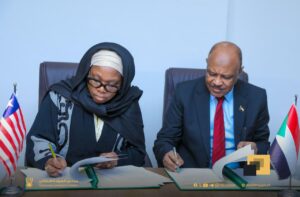
La visite de la ministre libérienne des Affaires étrangères, Sara Nyanti, accompagnée d’une délégation diplomatique, dans la capitale soudanaise Khartoum n’était pas une simple démarche protocolaire. Elle constitue plutôt une étape charnière dans la redéfinition de la cartographie des alliances politiques. L’importance de cette visite réside dans le fait qu’elle intervient quelques jours seulement après la 44ᵉ réunion des chefs d’état-major des armées de la Communauté économique des États de l’Afrique de l’Ouest (CEDEAO), tenue à Freetown à la fin du mois de février de l’année en cours.
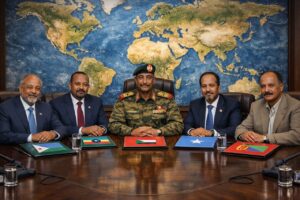
Sudan and the Horn of Africa: “Capitalizing on Developments”
During my postgraduate studies in political science, the course on strategy and national security was among the heaviest and most demanding subjects. It was the only course that generated an inner conflict within me—one I vowed to confront and overcome.
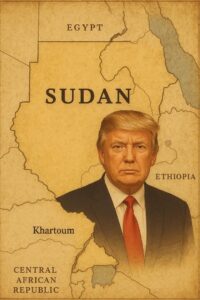
Sudan After Al-Fashir “When Power Redefines Truth”
A colleague in academic research recounted that, after the city of Al-Fashir fell into the hands of the multinational Rapid Support Forces (RSF), he coincidentally found himself with a senior French security official “residing in Africa.” According to his account, the official said verbatim:
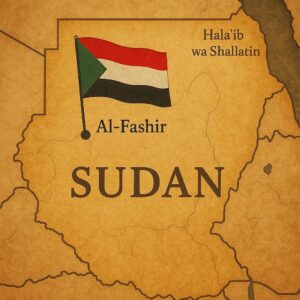
The Road to El Fasher “El Fasher is now, and it is the narrow passage that does not open twice.”
All global military schools emphasize that one of the fundamental principles underpinning military doctrine is the rule: “In national sovereignty battles, every moment the will hesitates, reality decides for us.”
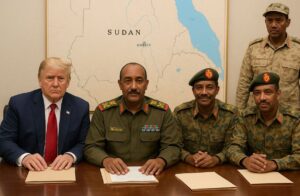
From Khartoum to Nyala: “Where Does Washington Stand?” (An Analysis of Sudanese State Negotiations)
The negotiations between the Sudanese army and the Rapid Support Forces (RSF), under American sponsorship and supervision, are not detached from the recent drone attacks targeting Khartoum airport and several Sudanese cities.

Scenarios of Elections in Côte d’Ivoire: Between the Past, the Present, and the Future
Introduction
Since Côte d’Ivoire gained independence in 1960, presidential elections have functioned as a mirror reflecting the nation’s social tensions, political confrontations, and structural transformations. With the advent of the multi-party system in 1990, elections became a key indicator of the evolution of the Ivorian political system—oscillating between phases of authoritarian stability and democratic uncertainty.